

How to Become a Successful Web Developer in 2026: A Step-by-Step Guide
How to Become a Successful Web Developer in 2026? The landscape of web development has shifted dramatically over the last few years. As we move into 2026, the role of a “Web Developer” has evolved from someone who simply writes syntax to an architect of digital experiences. With the integration of Generative AI, the rise of Edge Computing, and the dominance of Serverless architectures, the path to entry looks different than it did even two years ago.
If you are looking to break into the industry this year, you don’t just need to learn how to code—you need to learn how to build, orchestrate, and deploy in an AI-augmented world. This guide provides a comprehensive roadmap to becoming a job-ready web developer in 2026.
1. Mastering the Modern Fundamentals
While AI can generate code snippets, a professional developer must understand the “why” behind the “how.” Without a solid grasp of the basics, you won’t be able to debug the complex logical errors that AI inevitably produces.
The “Big Three” (Updated for 2026)
- HTML5 & Semantic Web: Focus on accessibility (a11y) and SEO. In 2026, search engines and AI crawlers prioritize well-structured, semantic HTML.
- Modern CSS: Move beyond basic styling. You must master CSS Grid, Flexbox, and Container Queries. Knowledge of “Utility-first” frameworks like Tailwind CSS v4+ is now a standard industry requirement.
- TypeScript (Not just JavaScript): In 2026, learning “plain” JavaScript is no longer enough for professional roles. TypeScript is the industry standard, providing the type safety required for large-scale applications.
2. Choosing Your Specialization(How to Become a Successful Web Developer in 2026)
Web development is too vast to “learn everything.” To remain competitive, you should choose a primary focus early on:
- Frontend Developer: Focuses on the user interface (UI) and user experience (UX). Key tools: React 19+, Next.js, or SvelteKit.
- Backend Developer: Focuses on server logic, databases, and APIs. Key tools: Node.js, Go (Golang), or Rust, alongside PostgreSQL or Vector Databases (for AI applications).
- Full-Stack Developer: The most versatile role. You manage everything from the database to the browser. This is currently the most high-demand role for startups in 2026.
3. The 2026 Tech Stack: What to Learn
The “MERN” stack has evolved. To stay ahead of the curve, your learning list should include:
Frameworks & Libraries
- Next.js & Server Components: Static sites are a thing of the past. Modern web development relies on Server-Side Rendering (SSR) and Edge Functions to deliver lightning-fast performance.
- State Management: Move away from overly complex Redux setups. Learn Zustand or TanStack Query for efficient data fetching and state handling.
Database & Infrastructure
- Serverless Databases: Learn platforms like Supabase, Neon, or PlanetScale. These allow you to scale without managing physical server hardware.
- Edge Computing: Understand how to deploy code to the “Edge” (closer to the user) using Vercel or Cloudflare Workers.
4. Embracing AI-Augmented Development
By 2026, the most successful developers aren’t those who resist AI, but those who orchestrate it. AI is no longer just a chatbot; it is integrated into your IDE (Integrated Development Environment).
- Prompt Engineering for Code: Learn how to write precise prompts to generate boilerplate, unit tests, and documentation.
- AI Debugging: Use tools like GitHub Copilot Next or Cursor to identify memory leaks and security vulnerabilities in real-time.
- Building AI-Powered Apps: You should know how to integrate LLM APIs (like OpenAI or Anthropic) into your web applications to provide features like intelligent search or automated content generation.
5. Building a “Proof of Competence” Portfolio
In 2026, a resume is just a formality; your GitHub profile and live portfolio are your real credentials. Employers are looking for high-quality, complex projects rather than dozens of simple “to-do list” apps.
Top Project Ideas for 2026:
- An AI SaaS Wrapper: A web app that connects to an API to solve a specific niche problem (e.g., an AI-driven legal document summarizer).
- Real-Time Collaborative Tool: Use WebSockets or Ably to build a multi-user dashboard (like a simplified Notion or Figma).
- Performance-Optimized E-commerce: A site achieving a 100/100 Lighthouse Score, demonstrating your knowledge of Core Web Vitals and image optimization.
6. Soft Skills: The “Human” Advantage
As technical tasks become more automated, “human-centric” skills have become the highest-valued assets in the tech industry.
- System Design: Can you explain how data flows from a user’s click to a database and back? Understanding the architecture is more important than memorizing syntax.
- Critical Thinking: AI often hallucinates or provides insecure code. Your job is to act as the Editor-in-Chief of the code, ensuring it is secure, scalable, and maintainable.
- Asynchronous Communication: With the continued dominance of remote work, being able to write clear documentation and Slack updates is vital for career growth.
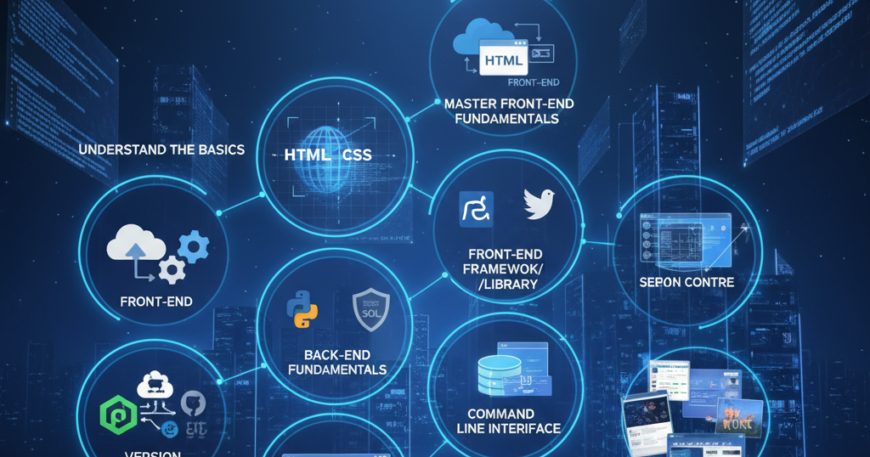
7. The Roadmap: Your First 6 Months
If you are starting from zero today, follow this aggressive 6-month timeline:
- Month 1: HTML, Modern CSS, and the basics of UI/UX design.
- Month 2: TypeScript fundamentals and DOM manipulation.
- Month 3: React or Svelte fundamentals (Components, Hooks, Props).
- Month 4: Full-stack integration (Next.js + Supabase).
- Month 5: AI Integration and Advanced Testing (Vitest/Playwright).
- Month 6: Portfolio polishing, networking on LinkedIn, and interview prep.