


The Blueprint for Success: Custom eCommerce Website Development
Custom eCommerce Website Development In the hyper-competitive world of online retail, a generic, template-based store is often not enough to capture and retain modern consumers. As global eCommerce sales continue to climb, businesses are realizing that a one-size-fits-all approach limits their ability to scale, innovate, and provide a truly unique brand experience.
Custom eCommerce website development is the process of building a tailored digital storefront from the ground up. Unlike platform-dependent templates, a custom solution is designed around your specific business logic, customer behavior, and long-term growth objectives. In this guide, we explore why custom development is the strategic choice for high-growth brands and the essential components required to build a market-leading online store.
Why Custom eCommerce Website Development Outperforms Templates
While platforms like Shopify or WooCommerce offer quick setups, they often come with “feature bloat” or restrictive layouts that can hinder performance. Custom development offers several distinct advantages:
- Scalability: A custom site is built to grow with you. Whether you have 100 products or 100,000, the architecture is optimized to handle high traffic and large databases without slowing down.
- Unique Brand Identity: Your website is your digital flagship store. Custom design ensures that every touchpoint—from the homepage to the checkout—aligns perfectly with your Brand Voice and visual identity.
- Optimized Conversion Funnels: You can design the user journey based on data-driven insights. By removing friction in the checkout process, custom sites often see a 20% to 30% increase in Conversion Rates compared to standard templates.
- Seamless Integrations: Custom builds allow for deep integration with your existing ERP (Enterprise Resource Planning), CRM (Customer Relationship Management), and inventory management systems, creating a unified data ecosystem.
Key Components of a Modern Custom eCommerce Store
Building a custom store requires more than just an “Add to Cart” button. To compete in 2024 and beyond, your site needs a foundation built on speed, security, and intelligence.
1. Headless Commerce Architecture
The most significant trend in custom eCommerce is the shift to Headless Commerce. By decoupling the frontend (the customer-facing side) from the backend (the engine that processes transactions), brands can deliver content to any device via APIs.
- Benefits: Faster loading speeds, the ability to update the design without touching the database, and a truly Omnichannel Experience.
2. Advanced Personalization Engines
Custom development allows you to integrate AI-driven recommendation engines that analyze user behavior in real-time.
- Impact: Personalized product suggestions and dynamic pricing can increase the Average Order Value (AOV) by up to 15%.
3. Progressive Web App (PWA) Functionality
A custom eCommerce site should function like a mobile app. By building your store as a PWA, you provide users with offline access, push notifications, and lightning-fast transitions, even on poor network connections.
4. Custom Checkout Logic
One of the leading causes of cart abandonment is a complex checkout process. Custom development allows for:
- One-Click Checkout for returning customers.
- Multi-Currency and Multi-Language Support based on the user’s IP address.
- Conditional Shipping Logic that calculates real-time rates based on warehouse proximity and product dimensions.
The Custom eCommerce Development Process
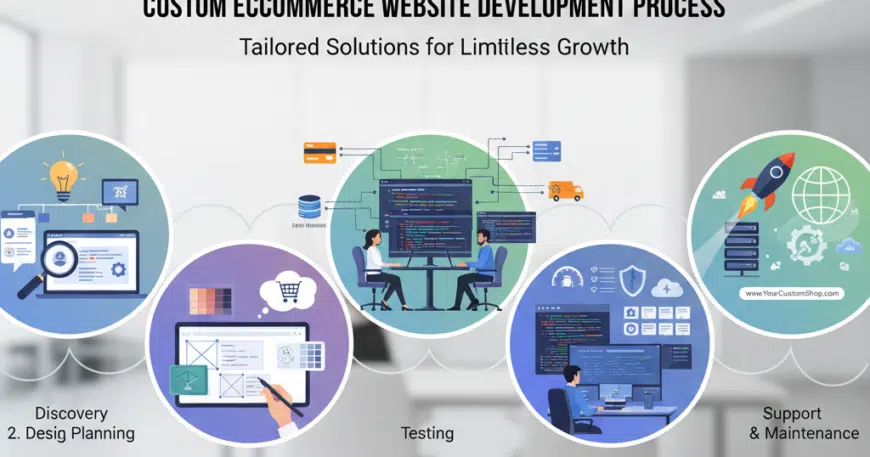
Building a high-performing store requires a structured approach. Here are the five critical stages of the development lifecycle:
Step 1: Discovery and Requirement Analysis
Before a single line of code is written, you must define the scope. This includes identifying your target audience, analyzing competitor gaps, and mapping out the Technical Stack (e.g., Node.js, React, or Python).
Step 2: UI/UX Design and Prototyping
A custom store must be intuitive. Designers create wireframes and high-fidelity prototypes that focus on Mobile-First Design. In this stage, every click is mapped to ensure the shortest path to purchase.
Step 3: Backend and Frontend Development
This is where the architecture is built. Developers set up the database, integrate secure payment gateways (like Stripe or PayPal), and build the frontend using modern frameworks to ensure the site is responsive across all devices.
Step 4: Quality Assurance (QA) and Testing
eCommerce sites are complex. Rigorous testing is required to ensure:
- Security: Performing penetration testing to protect customer data.
- Performance: Stress-testing the server to ensure it can handle seasonal spikes like Black Friday.
- Compatibility: Checking the site across all browsers and operating systems.
Step 5: Deployment and Post-Launch Optimization
Once the site is live, the work isn’t over. Continuous monitoring of Key Performance Indicators (KPIs)—such as bounce rate, load speed, and exit pages—allows for ongoing optimization.
Future-Proofing Your Online Store
As technology evolves, your custom eCommerce site must be ready to adapt. Here are the trends that will define the next generation of online shopping:
- Voice Commerce: Integrating with smart assistants to allow users to reorder products via voice command.
- Visual Search: Allowing customers to upload a photo to find similar products in your inventory.
- Augmented Reality (AR): “Try-on” features for apparel or “View in Room” features for furniture to reduce return rates.
- Sustainability Tracking: Displaying the carbon footprint of shipping options to appeal to eco-conscious consumers.
Measuring Success: The Metrics That Matter
When investing in custom development, you need to track the right data to ensure a high Return on Investment (ROI). Focus on these three metrics:
- LCP (Largest Contentful Paint): This measures how fast your primary content loads. For eCommerce, a score under 2.5 seconds is essential for SEO and user retention.
- Customer Acquisition Cost (CAC): A well-optimized custom site improves SEO, which can lower your reliance on paid ads and reduce your CAC over time.
- Customer Lifetime Value (CLV): By providing a superior UX and personalized loyalty programs, custom sites encourage repeat purchases, significantly boosting CLV.